24 June 2013 17:07
Work carried out at the University of Manchester has demonstrated a simple way to measure the abundance of protein molecules more accurately, which could help improve the reliability of many areas of biological and clinical research.
Measuring the abundance of protein molecules is a key part of many fields of life science and medicine, from analysing blood tests to studying human development to discovering new drugs. For proteomics – the study of all the proteins in a given system – reliably quantifying many proteins is an important yet challenging goal.
Accurate measurement is tricky because proteins are relatively large molecules, so scientists must often count protein fragments called peptides instead. The trouble is, proteins and peptides can stick to the containers used to store them and to the equipment used to measure them.
Building on previous research, the new study shows that peptide stickiness greatly reduces the accuracy of peptide quantification.
Accurate quantification of proteins is a key capability.
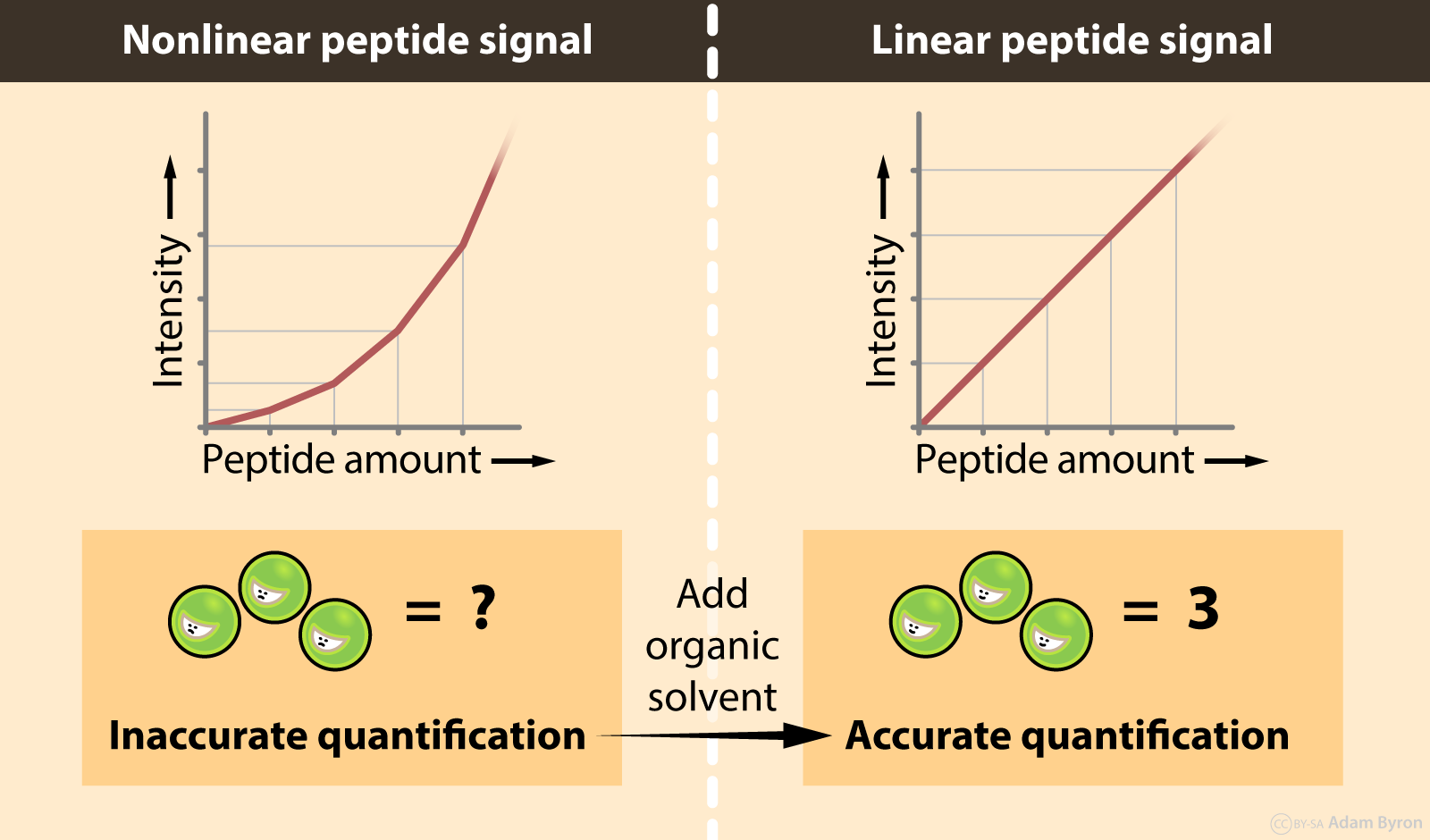
By making over 2100 measurements using a mass spectrometer (which is actually not that many in modern-day proteomics standards, but which enabled us to describe our findings), we showed that the detection of many peptides did not increase linearly as the amount of protein increased. A straight line graph of peptide signal intensity against protein concentration means you can calculate an unknown protein concentration from the intensity (see image, above). But a nonlinear peptide relationship makes it virtually impossible to work out the identity and abundance of protein molecules in a sample.
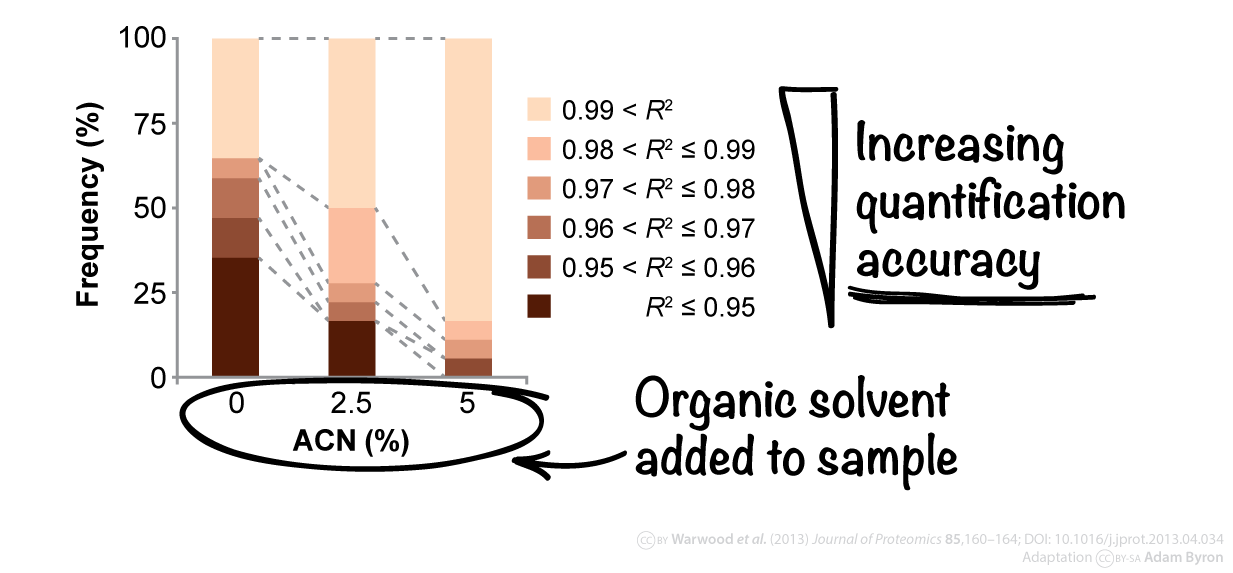
To overcome this problem, we found that the addition of a small amount of organic solvent to peptide samples dramatically improved the reliability of peptide quantification. The solvent worked a bit like a lubricant, preventing the sticking of peptide molecules.
A simple solution to a sticky struggle.
The work has been published as an open-access article in today’s issue of the Journal of Proteomics.
This method will be important for biologists studying cells of our body or model organisms, such as yeast, and for clinicians investigating drug targets or biomarkers of disease. For these fields and many others, accurate quantification of proteins is a key capability.
Funding: This work was supported by the Wellcome Trust.
Citation: S Warwood, A Byron, MJ Humphries, D Knight, The effect of peptide adsorption on signal linearity and a simple approach to improve reliability of quantification. J. Proteomics 85, 160–164 (2013). HTML | PDF | PubMed
Posted by adambyron
Categories: Publication, Research, Science
Tags: proteomics
Mobile Site | Full Site
Get a free blog at WordPress.com Theme: WordPress Mobile Edition by Alex King.
[…] growth. He then isolated the proteins in the cell adhesion complexes and analysed them using proteomics, an approach that measures all the proteins in a system. When microtubules were disrupted, there […]
By Microtubules and cell adhesion complexes | Adam Byron on 22 September 2015 at 00:21
[…] stem cells were catalogued. The clusters of proteins were isolated from cells and identified by proteomics, a technique that measures the type and number of proteins in a […]
By Sensing stem cells’ surroundings | Adam Byron on 18 February 2016 at 23:58